



How to Apply for Government Scholarships in India (Step-by-Step Guide for 2026)
Higher education can open the door to better career opportunities, but the cost of tuition, books, accommodation, and daily expenses can be challenging for many families. To make education more affordable, the Government of India and various state governments offer scholarships that provide financial support to deserving students.
Government scholarships are designed to help students from different backgrounds continue their education without worrying about financial difficulties. Whether you are studying in school, college, a university, or pursuing professional courses such as engineering, medicine, law, or management, there may be a scholarship that matches your eligibility.
Many students miss scholarship opportunities because they are unaware of the application process or believe it is too complicated. In reality, most government scholarship applications can be completed online by following a few simple steps and submitting the correct documents before the deadline.
This guide explains the complete scholarship application process in easy-to-understand language, making it useful for students, parents, and first-time applicants.
What Is a Government Scholarship?
A government scholarship is financial assistance provided by the Central Government or State Governments to help students pay for their education.
Unlike education loans, scholarships generally do not have to be repaid, provided students meet the scholarship rules and continue their studies according to the program’s requirements.
Scholarships are awarded for different reasons. Some are based on academic performance, while others support students from economically weaker sections, reserved categories, minority communities, or students with disabilities.
Why Government Scholarships Matter
Government scholarship programs help students continue their education regardless of their financial background.
Some important benefits include:
- Reduces the cost of education
- Helps students avoid unnecessary debt
- Encourages higher education
- Supports talented students
- Improves access to quality education
- Promotes equal educational opportunities
- Helps families manage education expenses
For many students, scholarships make the difference between continuing their education and leaving it due to financial constraints.
Types of Government Scholarships in India
Different scholarships are available for different categories of students.
| Scholarship Type | Suitable For |
|---|---|
| Merit-Based Scholarships | Students with excellent academic performance |
| Means-Based Scholarships | Students from low-income families |
| Pre-Matric Scholarships | Students studying before Class 10 |
| Post-Matric Scholarships | Students after Class 10 |
| Minority Scholarships | Students belonging to notified minority communities |
| SC/ST Scholarships | Scheduled Caste and Scheduled Tribe students |
| OBC Scholarships | Other Backward Class students |
| Scholarships for Students with Disabilities | Students with benchmark disabilities |
| Higher Education Scholarships | Undergraduate and postgraduate students |
| Professional Course Scholarships | Engineering, Medical, MBA, Law and similar courses |
Understanding the scholarship category helps students choose the right program before applying.
Who Can Apply?
Eligibility varies depending on the scholarship scheme, but most government scholarships consider the following factors.
| Eligibility Factor | Common Requirement |
|---|---|
| Nationality | Indian Citizen |
| Academic Qualification | Required minimum percentage or grade |
| Family Income | Income should be within the prescribed limit |
| Educational Institution | Recognized school, college, or university |
| Course | Eligible academic or professional course |
| Category | General, OBC, SC, ST, Minority or other eligible groups |
Always read the official scholarship guidelines before submitting an application.
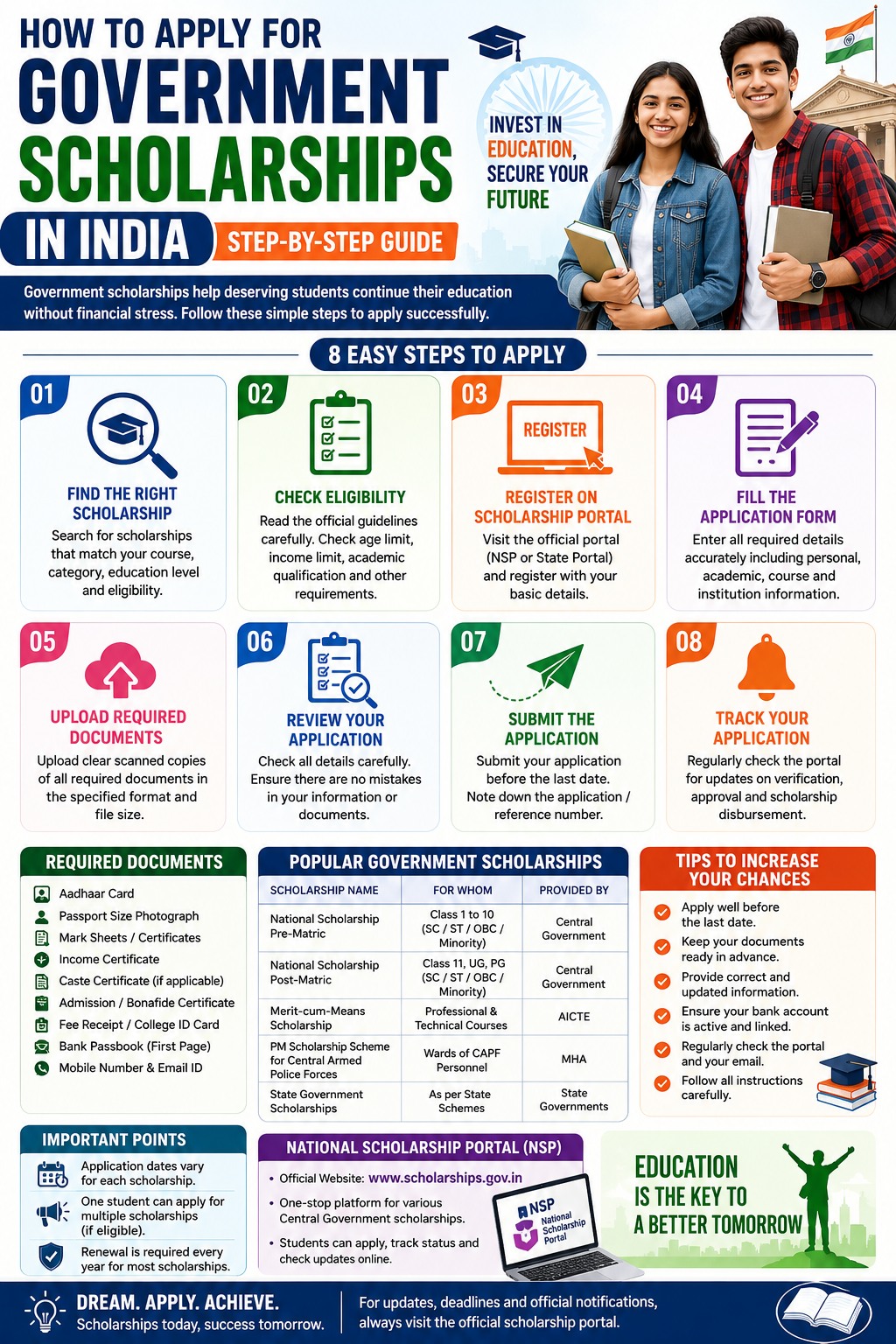
Documents Required
Preparing documents in advance makes the application process much easier.
| Document | Purpose |
|---|---|
| Aadhaar Card | Identity verification |
| Recent Passport Photograph | Application record |
| Educational Mark Sheets | Academic verification |
| Income Certificate | Family income proof |
| Caste Certificate (if applicable) | Category verification |
| Bank Passbook | Scholarship payment details |
| Admission Receipt | Proof of enrollment |
| Fee Receipt | Educational expense verification |
| Bonafide Certificate | Institution verification |
| Mobile Number and Email ID | Communication and updates |
Ensure that scanned copies are clear, readable, and uploaded in the required format.
Step 1: Find the Right Scholarship
Before applying, identify scholarships that match your educational level, family income, category, and course.
Many scholarships are available through:
- Central Government
- State Governments
- Ministries
- Educational Departments
- Universities
- Professional Institutions
Choosing the correct scholarship saves time and reduces the chance of rejection.
Step 2: Read the Eligibility Rules Carefully
Many applications are rejected because students do not meet basic eligibility requirements.
Before applying, carefully check:
- Age requirements
- Educational qualification
- Income limit
- Course eligibility
- Institution recognition
- Category requirements
- Last application date
Never assume you qualify without reading the official instructions.
Step 3: Register on the Scholarship Portal
Most Central Government scholarships are available through the National Scholarship Portal (NSP), while many states have their own scholarship portals.
During registration, students usually provide:
- Name
- Date of birth
- Aadhaar details (where required)
- Mobile number
- Email address
- Basic educational information
After successful registration, applicants receive login credentials to complete their application.
Step 4: Fill the Application Form
After logging in, carefully complete every section of the application.
Typical sections include:
- Personal information
- Family details
- Educational qualification
- Course details
- Institution information
- Bank account details
- Scholarship category
Double-check every entry before moving to the next section.
Step 5: Upload Required Documents
Most scholarship portals require scanned copies of supporting documents.
Before uploading:
- Check file size limits.
- Use clear scanned copies.
- Upload the correct document in each section.
- Avoid blurred photographs.
Incorrect documents are one of the most common reasons applications are rejected.
Step 6: Review Before Submission
Never submit your application without reviewing every detail.
Verify:
- Name spelling
- Aadhaar number
- Bank account number
- IFSC code
- Marks obtained
- Income certificate details
- Uploaded documents
A few minutes of careful checking can prevent unnecessary delays.
Step 7: Submit the Application
After reviewing the information, submit the application before the deadline.
Many scholarship portals also provide an acknowledgment or application reference number. Save this number for future tracking.
Scholarship Application Checklist
| Task | Completed |
|---|---|
| Read eligibility | ✔ |
| Selected correct scholarship | ✔ |
| Registered successfully | ✔ |
| Filled application form | ✔ |
| Uploaded documents | ✔ |
| Reviewed information | ✔ |
| Submitted application | ✔ |
| Saved application number | ✔ |
Common Mistakes Students Should Avoid
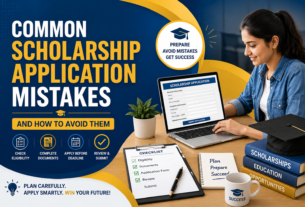
Many scholarship applications are rejected because of simple errors.
Avoid these common mistakes:
- Entering incorrect personal information
- Uploading unclear documents
- Missing the application deadline
- Providing incorrect bank details
- Forgetting required certificates
- Applying for an ineligible scholarship
- Ignoring portal notifications
Being careful throughout the application process greatly improves your chances of success.
Frequently Asked Questions (FAQs)
1. What is a government scholarship?
A government scholarship is financial assistance offered by the Central Government or State Governments to help eligible students pay for their education. Unlike an education loan, a scholarship generally does not need to be repaid if all eligibility conditions are met.
2. Who can apply for government scholarships in India?
Indian students studying in recognized schools, colleges, universities, or technical institutions may be eligible. Eligibility depends on factors such as academic performance, family income, category, course, and the specific scholarship guidelines.
3. Where can I apply for government scholarships?
You can apply through the National Scholarship Portal (NSP) for many Central Government schemes or through your respective State Government scholarship portal for state-specific scholarships.
4. Is there any application fee for government scholarships?
No. Genuine government scholarship applications are free. If a website asks for an application fee, verify whether it is an official government portal before making any payment.
5. What documents are required to apply?
The required documents usually include:
- Aadhaar Card
- Passport-size photograph
- Educational mark sheets
- Income certificate
- Caste certificate (if applicable)
- Bank account details
- Admission or bonafide certificate
- Fee receipt
- Mobile number and email ID
The exact requirements may vary depending on the scholarship.
6. Can I apply for more than one scholarship?
Yes, you may apply for multiple scholarships if you meet the eligibility criteria. However, some scholarship schemes do not allow students to receive benefits from two similar government scholarships at the same time. Always read the official rules.
7. How do I know if I am eligible?
Read the eligibility section carefully before applying. Check your academic qualification, family income, category, age, institution type, and course requirements against the scholarship guidelines.
8. How can I check my scholarship application status?
Log in to the scholarship portal where you submitted your application. Use your application number or registered login credentials to track the status.
9. What are the common reasons for scholarship rejection?
Applications may be rejected because of:
- Incorrect personal information
- Incomplete application forms
- Missing or unclear documents
- Incorrect bank account details
- Income exceeding the eligibility limit
- Applying after the deadline
- Not meeting the scholarship criteria
10. How long does it take to receive the scholarship amount?
The processing time varies by scholarship scheme. After successful verification and approval, the scholarship amount is generally transferred directly to the student’s registered bank account.
11. Can first-year college students apply?
Yes. Many government scholarship schemes are available for first-year undergraduate, postgraduate, diploma, and professional course students, provided they satisfy the eligibility requirements.
12. Can students from private colleges apply?
Yes, provided the private college or institution is recognized by the appropriate government authority and the scholarship scheme allows students from private institutions.
13. Is Aadhaar mandatory for every scholarship?
Many scholarship schemes require Aadhaar for identity verification. However, some schemes may provide alternative verification methods. Always check the official scholarship notification.
14. What should I do if I make a mistake in my application?
If the scholarship portal allows corrections, log in and update the information before the correction window closes. If corrections are not permitted, contact the scholarship helpdesk or your institution immediately.
15. How can I improve my chances of getting a scholarship?
You can improve your chances by:
- Applying before the deadline
- Filling out the application carefully
- Uploading clear and correct documents
- Meeting all eligibility requirements
- Keeping your academic records updated
- Regularly checking application status and notifications
16. Do government scholarships have to be renewed every year?
Some scholarships require annual renewal based on academic performance and continued enrollment. Read the renewal guidelines of your specific scholarship carefully.
17. Are government scholarships available for MBA, Engineering, Medical, and Law students?
Yes. Many Central and State Government scholarship schemes support students pursuing professional courses, including MBA, Engineering, Medical, Law, Pharmacy, Agriculture, and other higher education programs, subject to eligibility.
18. Can I receive the scholarship amount directly in my bank account?
Yes. Most government scholarships are disbursed through Direct Benefit Transfer (DBT), where the approved scholarship amount is credited directly to the student’s verified bank account.
19. What happens if I miss the application deadline?
Generally, late applications are not accepted. It is advisable to check scholarship notifications regularly and submit your application well before the closing date.
20. Where can I find the latest government scholarship announcements?
You can find updated scholarship notifications on the National Scholarship Portal, State Government scholarship portals, official education department websites, and notifications issued by recognized universities and educational institutions.