



Google Data Analytics Professional Certificate: Complete Guide, Career Benefits, Fees & Job Opportunities (2026)
Data has become one of the most valuable resources in today’s digital world. Every day, businesses collect information about customers, sales, products, websites, and services. However, raw data alone has little value unless someone can understand it and turn it into useful insights. This is where data analysts play an important role.
As companies continue to rely on data for decision-making, the demand for skilled data analysts is growing rapidly across industries such as healthcare, finance, retail, technology, education, and manufacturing. Many organizations are looking for professionals who can collect, organize, analyze, and present data in a way that helps businesses make smarter decisions.
The Google Data Analytics Professional Certificate is designed for people who want to begin a career in data analytics without needing a college degree or previous work experience. The program focuses on practical skills that employers value and helps learners build confidence through hands-on projects.
Whether you are a student, a working professional looking for a career change, or someone interested in learning new technical skills, this certificate can be a strong first step toward a career in data analytics.
In this guide, you’ll learn what the course includes, who should take it, the skills you’ll gain, career opportunities, and why it has become one of the most popular online professional certificates.
What Is the Google Data Analytics Professional Certificate?
The Google Data Analytics Professional Certificate is an online training program created by Google to prepare beginners for entry-level data analyst roles. It is available through the Coursera learning platform and is designed to teach practical, job-ready skills.
Unlike many technical courses, this certificate starts with the basics. It explains key concepts in simple language, making it suitable even for learners with no previous experience in programming, statistics, or analytics.
Throughout the course, learners work with real-world examples and practice using popular data analysis tools. Instead of only reading theory, students complete activities and projects that help them understand how data analysis is performed in professional workplaces.
The certificate focuses on solving business problems using data. By the end of the program, learners create a portfolio of projects that can be shared with potential employers.
Why Is This Certificate Popular?
Many people choose this certificate because it is designed for beginners and focuses on practical skills rather than complex theory.
Some of the reasons behind its popularity include:
- Beginner-friendly learning approach
- Flexible online study schedule
- Industry-recognized certificate from Google
- Hands-on projects for practical experience
- Skills that match current employer requirements
- Opportunity to build a professional portfolio
- Preparation for entry-level data analyst positions
The course is updated regularly to reflect modern industry practices, making it relevant for today’s job market.
Who Should Take This Course?
This certificate is suitable for a wide range of learners.
It is an excellent choice for students who want to build technical skills before graduating. Working professionals can use it to transition into data-related careers, while business owners can learn how to make better decisions using data.
The course is also useful for freelancers who want to offer data analysis services and for anyone curious about how businesses use information to improve performance.
You do not need a technical background to begin learning.
Skills You Will Learn
The Google Data Analytics Professional Certificate teaches practical skills that are widely used in the workplace.
Some of the major skills include:
| Skill | Why It Is Important |
|---|---|
| Data Collection | Learn how to gather useful information from different sources. |
| Data Cleaning | Remove errors and organize data for accurate analysis. |
| Spreadsheet Analysis | Work efficiently with large datasets using spreadsheets. |
| SQL | Retrieve and manage information stored in databases. |
| Data Visualization | Present findings through charts, graphs, and dashboards. |
| Data Interpretation | Understand patterns and trends to support business decisions. |
| Problem Solving | Use data to answer business questions effectively. |
| Communication | Explain insights clearly to managers and stakeholders. |
These skills are valuable across many industries and can be applied in different job roles.
Tools Covered in the Course
One of the strengths of this certificate is that learners gain experience with commonly used analytics tools.
The program introduces several important tools used by professional data analysts.
| Tool | Purpose |
|---|---|
| Google Sheets | Organize and analyze data |
| Microsoft Excel | Perform calculations and data management |
| SQL | Query and manage databases |
| Tableau | Create interactive dashboards and visual reports |
| R Programming | Perform statistical analysis and data visualization |
Learning these tools helps students become familiar with the software used by many employers.
Why Data Analytics Is a Growing Career
Almost every industry generates large amounts of information every day. Businesses want to understand customer behavior, improve products, reduce costs, and increase profits. Data analysts help organizations achieve these goals by turning raw information into meaningful insights.
For example:
A retail company analyzes customer purchases to understand buying habits.
A hospital studies patient data to improve healthcare services.
A bank uses transaction data to detect unusual activities and reduce fraud.
An online business tracks website visitors to improve sales and customer experience.
Because data plays such an important role in decision-making, skilled analysts are becoming increasingly valuable.
Benefits of Learning Data Analytics
Learning data analytics offers more than just job opportunities. It also improves problem-solving abilities and helps individuals make informed decisions based on evidence rather than assumptions.
Some key benefits include:
| Benefit | Description |
|---|---|
| Better Career Opportunities | Many industries actively hire data analysts. |
| High Demand | Data-related jobs continue to grow worldwide. |
| Practical Skills | Learn tools used by real businesses. |
| Career Flexibility | Work in healthcare, finance, retail, technology, education, and more. |
| Better Decision Making | Understand how to analyze information effectively. |
| Continuous Learning | Build a foundation for advanced analytics and AI. |
Course Modules and Curriculum
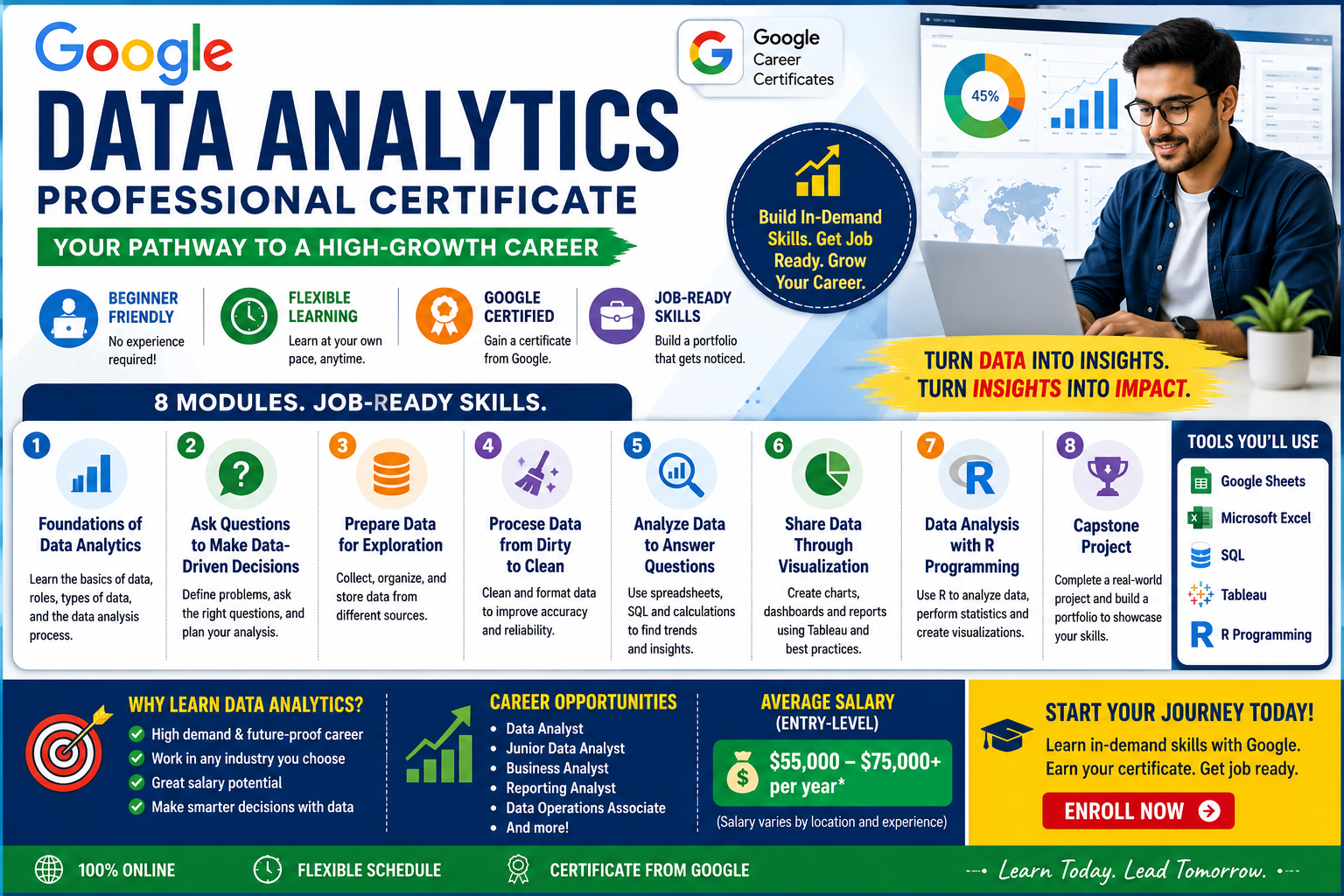
The Google Data Analytics Professional Certificate is designed to take beginners from the basics of data analysis to job-ready skills. The course is divided into several modules, with each one focusing on a different stage of the data analysis process. Instead of only teaching theory, every module includes practical activities, quizzes, and hands-on projects to help learners apply what they have learned.
By the end of the program, students complete a portfolio project that demonstrates their ability to analyze data and present meaningful insights. This portfolio can be shared with potential employers during job applications.
Module 1: Foundations of Data Analytics
The first module introduces the world of data analytics and explains why data is important for businesses. Learners discover what a data analyst does, how organizations use data to make decisions, and the key stages of the data analysis process.
Topics covered include:
- Introduction to data analytics
- Roles and responsibilities of a data analyst
- Types of data
- Data-driven decision-making
- Ethics and data privacy
- Career opportunities in data analytics
This module provides a solid foundation before moving on to technical skills.
Module 2: Ask Questions to Make Data-Driven Decisions
A successful data analysis project begins with asking the right questions. In this module, learners understand how businesses identify problems and define project goals before collecting data.
Key topics include:
- Defining business problems
- Asking effective analytical questions
- Understanding stakeholders’ needs
- Project planning
- Creating project documentation
- Setting measurable objectives
This module teaches critical thinking and structured problem-solving.
Module 3: Prepare Data for Exploration
Before data can be analyzed, it must be collected and organized properly. This module explains how analysts gather data from different sources while ensuring its quality and accuracy.
Students learn about:
- Data collection methods
- Data sources
- Organizing datasets
- Spreadsheet fundamentals
- Data storage
- Data security
- File management
Good preparation helps produce reliable analysis later in the project.
Module 4: Process Data from Dirty to Clean
Real-world data often contains mistakes, missing values, duplicate records, or formatting issues. This module teaches learners how to clean and prepare data before analysis.
Topics include:
- Identifying data errors
- Removing duplicate records
- Correcting formatting problems
- Handling missing values
- Data validation
- Data integrity
- Cleaning datasets using spreadsheets and SQL
Clean data leads to more accurate business decisions.
Module 5: Analyze Data to Answer Questions
This module introduces analytical techniques that help transform raw information into meaningful insights. Students begin working with larger datasets and learn how to identify trends and patterns.
Topics covered include:
- Data exploration
- Sorting and filtering
- SQL queries
- Basic calculations
- Aggregating data
- Identifying trends
- Comparing datasets
Learners also practice solving real business questions using data.
Module 6: Share Data Through Visualization
Numbers alone are often difficult to understand. Data visualization helps communicate findings clearly through charts, graphs, and dashboards.
This module teaches learners how to present information in a way that decision-makers can easily understand.
Topics include:
- Principles of data visualization
- Creating charts and graphs
- Dashboard design
- Storytelling with data
- Presenting business insights
- Choosing the right visualization
Students gain experience using visualization tools such as Tableau.
Module 7: Data Analysis with R Programming
R is a popular programming language used for statistical analysis and data visualization. This module introduces basic programming concepts in a beginner-friendly way.
Learners study:
- Introduction to R
- Installing R and RStudio
- Variables and functions
- Importing datasets
- Data manipulation
- Creating visualizations
- Basic statistical analysis
No previous programming experience is required.
Module 8: Capstone Project
The final module combines everything learned throughout the course. Students complete a real-world case study by following the complete data analysis process.
The capstone project includes:
- Defining a business problem
- Collecting data
- Cleaning datasets
- Analyzing information
- Creating dashboards
- Preparing a professional report
- Presenting findings
Completing this project helps learners build a portfolio that demonstrates practical skills to employers.
Course Curriculum Overview
| Module | Main Topics | Skills Developed |
|---|---|---|
| Module 1 | Foundations of Data Analytics | Understanding the role of a data analyst |
| Module 2 | Ask Questions | Business problem-solving and project planning |
| Module 3 | Prepare Data | Data collection and organization |
| Module 4 | Process Data | Data cleaning and quality improvement |
| Module 5 | Analyze Data | SQL, spreadsheets, and data analysis |
| Module 6 | Share Data | Visualization, dashboards, and storytelling |
| Module 7 | R Programming | Basic programming and statistical analysis |
| Module 8 | Capstone Project | End-to-end data analytics project and portfolio creation |
What You’ll Achieve After Completing the Curriculum
After completing all modules, learners will be able to:
- Understand the complete data analysis process.
- Collect, clean, and organize data efficiently.
- Analyze business problems using real datasets.
- Write basic SQL queries.
- Create professional charts and dashboards.
- Use spreadsheets for data analysis.
- Perform basic data analysis with R.
- Present findings clearly to stakeholders.
- Build a portfolio suitable for entry-level data analyst job applications.
The curriculum is designed to provide practical, job-ready skills that employers value, making it an excellent starting point for anyone beginning a career in data analytics.
Summary
The Google Data Analytics Professional Certificate is an excellent starting point for anyone interested in entering the field of data analytics. It provides beginner-friendly training, practical projects, and valuable technical skills that are relevant across many industries. As businesses increasingly rely on data to guide decisions, professionals with analytics skills continue to be in high demand.